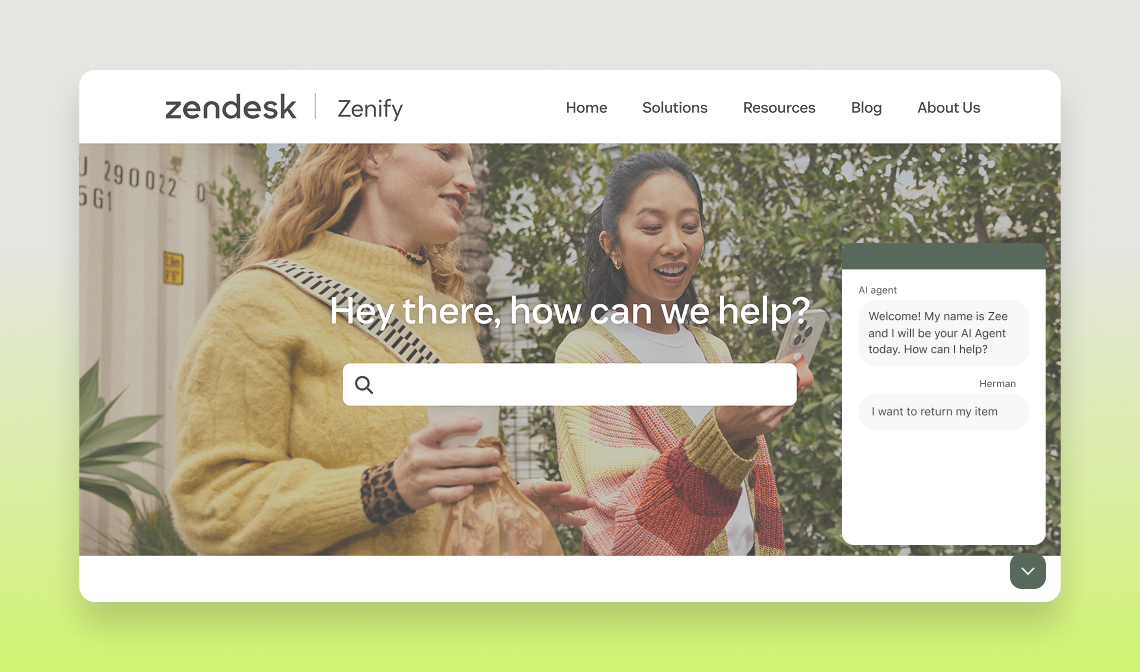
Agentic Retail Experience

Follow the instructions and storyline below to guide your customers & prospects through our agentic capabilities. Once you feel comfortable with the recommended storyline, feel free to get creative and come up with your own!

Open widget

Agentic-Retail-videothumbnail
play Watch

Overview

This is the next era of our AI Agents—smarter, sharper, and ready to engage in real conversations like never before. These agents don’t just answer questions; they get you. Small disclaimer - they might also make mistakes or say weird things, but this is what we are fine-tuning through the EAP. The benefits are they disambiguate, provide a seamless user experience, and require less setup, meaning more impact all around.

Bringing together content from our existing Industry demos we can give you a look into what the future and comparison could be. 

For this demo, check out the documentation below for paths you can take and tips to ensure your flow shines —enjoy!

Recommended Storyline

You are a recent customer of a clothing retailer, you recently made your first purchases and now you want to check on how to retrieve your invoices as well as enquiring about the membership options because you heard there were discounts associated with it.

You’re also eager to receive your newly ordered items and want to know the status of your orders and finally returning a lipstick kit that was not to your taste.

  • How does our EAP work?

    This is the next era of our AI Agents—smarter, sharper, and ready to engage in real conversations like never before. These agents don’t just answer questions; they get you. Small disclaimer - they might also make mistakes or say weird things, but this is what we are fine-tuning through the EAP. The benefits are they disambiguate, provide a seamless user experience, and require less setup, meaning more impact all around.

    Bringing together content from our existing Industry demos we can give you a look into what the future and comparison could be. 

    For this demo, check out the documentation below for paths you can take and tips to ensure your flow shines —enjoy!
    For this EAP, we can only accept customers using Messaging and that we are working with directly.

    There are technical limitations that can be learned about in the learning linked above. 
    If your customer fits these requirements, consult with your mapped AI Specialist, then invite the user/prospect to fill this sign up form (⚠️ the customer has to fill this form themselves).

    Want to learn about what's available and what's coming - check out the Overview and Roadmap video (recorded April 2025) for more details. Targeted general availability date is by end of Q3 2025

  • What are the four agent types used in our Agentic AI?

    RAG Agent

    A new and improved RAG agent with enhanced search and retrieval capable of handling more complex and conversational FAQs. Here too, the Agent is capable of asking clarifying questions to improve its search query and get a more accurate response. The RAG Agent also handles more context by parsing more results so we expect it to improve our answer rates as well! Think of this agent like a librarian that looks up information in the database and gets you the relevant resources.

    Task Identification Agent

    The agent that interacts with users and other agents in the system to help resolve queries. Instead of predicting a user’s intent based off of a single message - this agent can hold a conversation, can disambiguate and ask clarifying questions until it reaches a conclusion. This agent also handles all “Small talk” interaction and generally allows us to handle conversations more gracefully end to end. This is the receptionist that makes sure you know what you need and sends you to the right place.

    Procedure Compilation Agent

    The core AI method which takes the user description (policy) as input and generates a new structured version of the Procedure - to be used both by the PEA but also an easier way for users to review their procedures in a visual way. This can be thought of as your architect. You tell them what kind of structure you want and they design it, put it into a visual structure that can be followed by others.

    Procedure Execution Agent

    This agent can execute generative procedures and adapt those to real-time conversations rather than follow scripted dialogues. This agent will also invoke CRM Actions and API integrations. You could consider this agent to be your cook - someone else has figured out the details of the recipe and the cooking agent will execute. They are repsosnible of seeing the job done and putting resources as needed. However they also have the autonomy to make changes on the fly based on the information they receive.

  • Where can I find more resources about the Agentic release?

    Learn more about this release here (Agentic AI Agent Training).

    For general information about AI Agents, visit our hub here.

Suggested demo flow

Knowledge Sourcing (RAG Agent)

Don’t refer to these examples as RAG Agent examples, just know that this is the feature you’re highlighting.

This is all about being able to conversationally clarify questions around the knowledge sources, sometimes it will clarify first of all, other times, it will give general information and then ask for specifics to dig deeper - but then it will do a search in the knowledge sources to give contextual answers. 

Questions to trigger Generative replies from the RAG Agent. 

  • Where can I find my last invoice?
  • How do I become a member? 
  • Do you ship internationally?
You can combine multiple questions in one for the RAG Agent to provide a summarized answer of multiple articles.

Key Value

No need to create use cases for FAQ requests which are documented in your help centres or sources. This means up-to-date content is shared with users and there is no need to maintain two systems and no requirement to build out these use cases - leading to less build time - faster time to launch or can prioritise quality in use cases that are built. 

Task Identification (TI Agent) & Task Classification Agent

Conversational Disambiguation between Use Cases 

Don’t refer to these examples as TI Agent examples, just know that this is the feature you’re highlighting.

You should mention that these are the ability for the AI Agent to disambiguate and create clarity for the user. This is where the real difference comes in as the AI Agent is able to conversationally clarify between the different use cases / procedures available in the AI Agent.

Getting to Your Order Status Flow

This forces the AI Agent to ask for clarity so they can lead the user to the right place.
  1. Ask “I need an update” 
  2. Depending on the reply from the AI Agent (as its generative it will be slightly different every time), they may provide options to dive deeper or ask you to specify what specifically you need an update on. 
  3. Follow up with “Where's my stuff?” or “Can I check on my purchase?”
  4. This will then trigger the next step - the Order Status Procedure

Key Value

Gracefully handling ambiguous messages and driving the user to flows it thinks could help, all without those replies being defined at all. Creating a better customer experience and easy for the bot builder as this doesn’t need to be created.

Again here, in the frontend experience the goal is to show that despite vague instructions the AI agent is staying conversational and bringing you always on the right path (procedure).

Procedures

Procedures are a way of defining a user flow, without the strict structure of a dialogue flow. The AI agent will not be looking for a specific answer, so you can be a bit more ambiguous (asking to precise an answer with vague context) to demonstrate the power of our agentic approach and “play” with the AI Agent to test its limits (it should always stay conversational and bring you back to the flow).

Order Status Flow

Continuing on from where we left off, the AI Agent will ask for an email - which you should provide. 

4 orders will be displayed. The AI agent will ask which one you want an update on.

You can follow-up with “the third one” instead of stating the order number or say “the one with the lipstick kit”.

The AI agent will provide additional details on this specific order, which we will want to return in our next step.

Key Value

Procedures can be set up in minutes with no technical support or expert training - it’s as simple as explaining the task as you would to a new team member. When procedures are created, they are displayed on a visual flow canvas, so it’s easy to follow the chain of understanding. The benefit - it’s not rigid, and understands human ways of speaking and behaviour. No more looping or breaking bot experiences for customers, ensuring a great customer experience leading to resolutions - thus value for the company too.

Dialogues

The scripted structures you know and love are still here, and this solution isn’t an all-or-nothing, users can define which flows they want to be procedures and those they want to keep fully human defined. This also means customers who aren’t ready to commit to procedures can try with one without changing their entire set-up - this helps to build confidence in the latest innovation and drive change scalably. 

Return Process

At this stage, because the lipstick kit has been delivered and you are eligible for return, you want to start this scripted flow by asking:

“Can I return this order” or a similar sentence.

At this point you will be following a more “rigid” flow asking you to choose which item to return, specifying the return reason and choosing a date and modality of return.

The benefit of this approach is to have a more controlled experience on specific use cases that would be more sensitive to certain customers such as return policies

Key Value

There is a solution for every type of use case and based on customers innovation, adoption and comfort around change. It is not a one or the other choice, making it easy to test, iterate and scale.

There is also a strong argument on controlled environments, from our experience a lot of customers would prefer to rely on controlled dialogues for certain use cases especially when it comes to having APIs involved and controlling when these are triggered.

Customer satisfaction

All flows end in a customer satisfaction request which can determine whether a user would receive the option to be escalated to a human agent (in real life) to further assist them. This is done by asking the user to rate service with a smiley face system, however this could also be changed to be stars based on their preference.

BSAT

The bot will ask you if there is anything they can help with - select no. The BSAT reply will then be triggered with smiley faces for you to provide feedback. 

Key Value

Ensure you are getting data from customers on their experience and determine if they receive resolutions in the bot, and if not, ensure they have the opportunity to speak to a human, so you don’t lose a customer based on a bad experience.

Additional Resources

Need a specialist?

Visit the Center of Excellence for specialized support on deals & accounts

Got feedback?

Submit your feedback in this form to let us know how we’re doing.

Bieten Sie mit Ultimate besseren, schnelleren und effizienteren Kundensupport

G2-Badges-Winter23 G2-Spitzenreiter